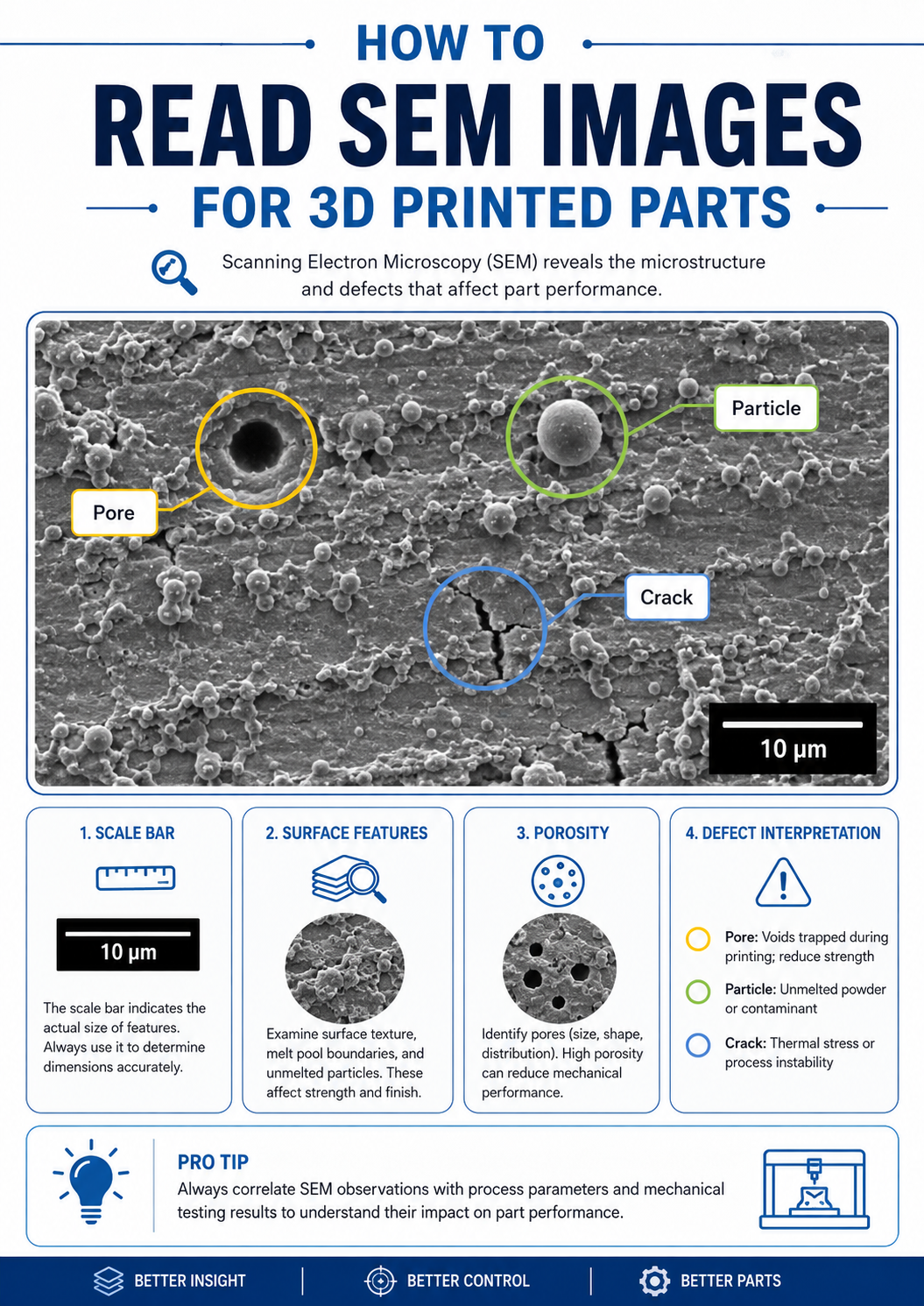
SEM images are often used to examine 3D printed parts, powders, fracture surfaces, and defects.
They can show details that are difficult to see with the naked eye or with a normal camera.
However, SEM images can also be confusing for beginners.
A clear image does not automatically mean that the interpretation is correct.
📌 Key Summary
When reading SEM images, do not look only at the shape.
Check the scale bar, observation area, surface condition, particle shape, pores, cracks, and imaging condition together.
SEM images are not normal photographs
SEM stands for Scanning Electron Microscope.
Instead of using visible light, SEM uses an electron beam to observe the surface of a sample.
This makes it possible to see very small surface features.
For 3D printed parts, SEM can be used to observe powder particles, partially melted regions, fracture surfaces, surface roughness, or contamination.
However, SEM images are usually grayscale images.
The brightness and contrast can be affected by the imaging condition, detector type, surface geometry, and material behavior.
So it is not enough to simply say that a bright area or dark area has one fixed meaning.
The observation condition must be considered.
Always check the scale bar
One of the most important parts of an SEM image is the scale bar.
Magnification alone can be misleading because the displayed image size can change depending on the screen or document format.
The scale bar tells you the actual size of the feature in the image.
Without checking it, a small particle and a large particle may look similar.
For 3D printed parts, this is especially important when evaluating powder size, pore size, surface defects, or microcracks.
Know what area you are looking at
SEM interpretation depends strongly on the observation area.
A surface image, cross-section image, and fracture surface image show different information.
A surface image may show adhered powder, melt tracks, layer marks, or surface roughness.
A cross-section image can show internal pores, lack-of-fusion defects, or microstructural features.
A fracture surface image can help identify brittle fracture, ductile fracture, crack paths, or fatigue-related features.
Before interpreting the image, first ask where the sample was taken from.
📋 Checklist
| Scale bar | Actual size of particles, pores, or cracks |
| Observation area | Surface, cross-section, or fracture surface |
| Particle shape | Spherical, irregular, satellite particles, or contamination |
| Pores | Size, shape, and distribution |
| Cracks | Direction, length, and connection to defects |
| Surface condition | Melt marks, attached powder, roughness, or damage |
| Imaging condition | Magnification, detector, and sample preparation |
✅ Final Notes
SEM is a powerful tool for analyzing 3D printed parts, but the image must be interpreted carefully.
A single SEM image should not be used to explain every problem.
For better analysis, SEM results should be compared with other information such as density measurement, cross-section inspection, surface roughness data, chemical analysis, or process history.
'장비·시험분석' 카테고리의 다른 글
| Common Metal 3D Printing Defects: Porosity, Warping, and Surface Roughness (0) | 2026.05.23 |
|---|---|
| 3D Optical Profiler in 3D Printing: When and Why to Use It (0) | 2026.05.22 |
| PETG·TPU·Nylon 필라멘트 건조 기준과 보관 방법 (0) | 2026.05.18 |
| 3D Optical Profiler로 표면거칠기를 측정하는 방법 (0) | 2026.05.17 |
| 노즐 직경 0.4·0.6·0.8mm 선택 기준 (0) | 2026.05.12 |


