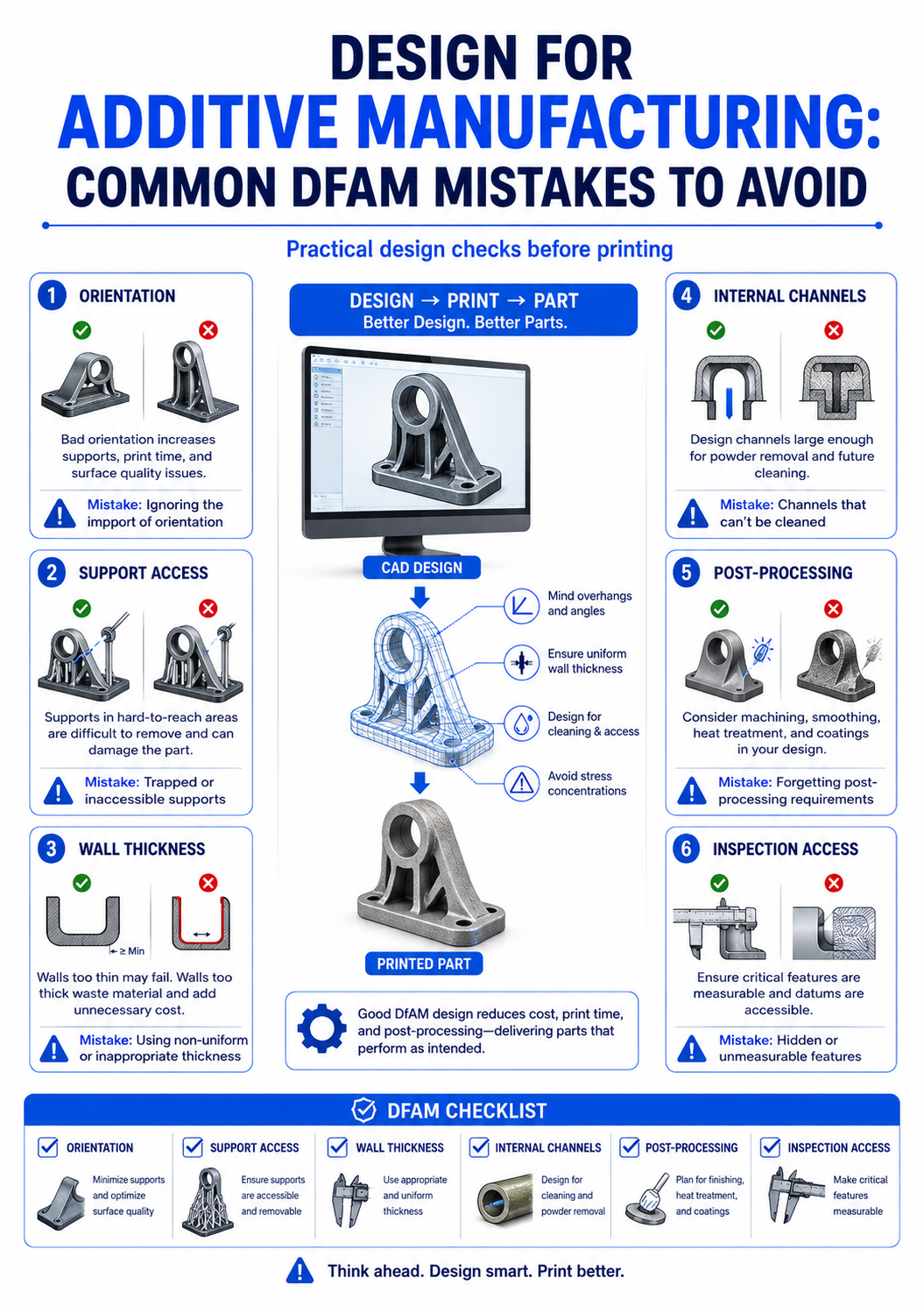
Design for Additive Manufacturing, often called DfAM, means designing parts with 3D printing in mind.
A part that looks good in CAD is not always easy to print.
Many beginners design parts as if they were going to be machined, molded, or cut from a block.
However, additive manufacturing has its own rules, opportunities, and limitations.
📌 Key Summary
DfAM is not only about making complex shapes.
Good 3D printing design should consider orientation, supports, wall thickness, powder or resin removal, surface quality, and post-processing.
Mistake 1: Ignoring print orientation
Print orientation affects surface quality, strength, support needs, and build time.
The same part can produce very different results depending on how it is placed in the build space.
For FDM parts, orientation affects layer strength and visible layer lines.
For resin prints, orientation affects peel force and support marks.
For metal PBF parts, orientation affects supports, heat behavior, and distortion risk.
Orientation should be decided early, not after the design is finished.
Mistake 2: Adding complex geometry without purpose
3D printing allows complex shapes, but complexity should have a reason.
Lattices, internal channels, thin walls, and organic shapes can be useful, but they can also make inspection and post-processing more difficult.
A complex design may look impressive, but it may not be practical if powder cannot be removed, supports cannot be accessed, or surfaces cannot be finished.
DfAM should balance design freedom with manufacturing reality.
Mistake 3: Forgetting post-processing
A printed part is rarely finished immediately after printing.
Support removal, cleaning, curing, heat treatment, machining, blasting, polishing, or coating may be needed.
If the design does not allow access for tools or cleaning, post-processing becomes difficult.
This is especially important for metal 3D printing and resin printing with hollow structures.
📋 Checklist
| Orientation | Strength, surface quality, and support needs |
| Support access | Supports can be removed safely |
| Wall thickness | Thin walls are printable and strong enough |
| Internal channels | Powder, resin, or support material can be removed |
| Surface quality | Critical surfaces are placed carefully |
| Post-processing | Machining, cleaning, or finishing is possible |
| Inspection | Important features can be measured or verified |
✅ Final Notes
DfAM is not just about making a part printable.
It is about designing a part that can be printed, cleaned, finished, inspected, and used.
A good additive manufacturing design starts with the final use in mind.
Before printing, check whether the geometry is practical for the selected process, material, and post-processing workflow.
'3D프린팅 공정' 카테고리의 다른 글
| 3D프린팅 공정별 차이와 선택 기준 총정리 (0) | 2026.05.28 |
|---|---|
| SLS와 MJF 차이, 산업용 출력 방식 선택 기준 (0) | 2026.05.22 |
| What Is Powder Bed Fusion? PBF 3D Printing Explained Simply (0) | 2026.05.20 |
| PBF 방식 금속 3D프린팅 공정 쉽게 정리 (0) | 2026.05.17 |
| 입력 쉐이핑으로 FDM 표면 흔들림 줄이는 방법 (0) | 2026.05.09 |


